Farooq & Omar Abdullah Renew J&K Statehood Fight as Article 370 Anniversary Reopens Political Battle
By News Desk | 06 Aug 2026
The National Conference has renewed its campaign for the restoration of Jammu and Kashmir’s statehood, with party president Farooq Abdullah and Chief Minister Omar Abdullah insisting that the demand will remain on the political agenda until the Union Territory is restored to full statehood.
Their renewed push came around the seventh anniversary of the August 5, 2019 constitutional changes, when Jammu and Kashmir lost its special status and was reorganised into the Union Territories of Jammu and Kashmir and Ladakh.
The issue has now evolved into a distinct political battle from the question of Article 370 itself. While the National Conference continues to oppose the 2019 changes, restoration of statehood has emerged as the party’s immediate and most politically actionable demand. Recent statements from both Farooq and Omar Abdullah underline that the NC intends to keep pressure on New Delhi through Parliament, public campaigns and political mobilisation.
Statehood Becomes NC’s Central Political Demand
For the National Conference, the demand for statehood is no longer simply an institutional question. Party leaders increasingly frame it as a matter of political dignity, democratic accountability and the restoration of Jammu and Kashmir’s pre-2019 constitutional status as a state.
Farooq Abdullah has repeatedly argued that the people of Jammu and Kashmir are seeking their rights and dignity rather than a political favour. In recent months, he has urged the Centre to restore statehood without further delay.
Omar Abdullah has adopted a similar line, arguing that his government and the National Conference will continue the campaign until statehood is restored.
Speaking after the August 5 anniversary, Omar said the fight would continue “until it is restored”, reinforcing the message that the NC does not intend to allow the statehood issue to disappear from public debate.
Farooq Abdullah: Statehood Is About Dignity, Not Power
Farooq Abdullah has sought to frame the statehood campaign in broader constitutional terms.
For the veteran NC leader, the issue is not simply about giving elected politicians greater administrative authority. It is about restoring the political status that Jammu and Kashmir enjoyed before its reorganisation in 2019.
His recent statements have repeatedly linked statehood with rights, dignity and democratic representation.
In July, Farooq urged Parliament to pass legislation restoring Jammu and Kashmir’s statehood, describing restoration as a constitutional and democratic imperative rather than merely a political demand.
That argument allows the NC to take the statehood issue beyond party politics and present it as a question of institutional trust between Jammu and Kashmir and New Delhi.
Omar Abdullah Takes the Fight to Parliament and the Streets
Chief Minister Omar Abdullah has taken a more direct political approach.
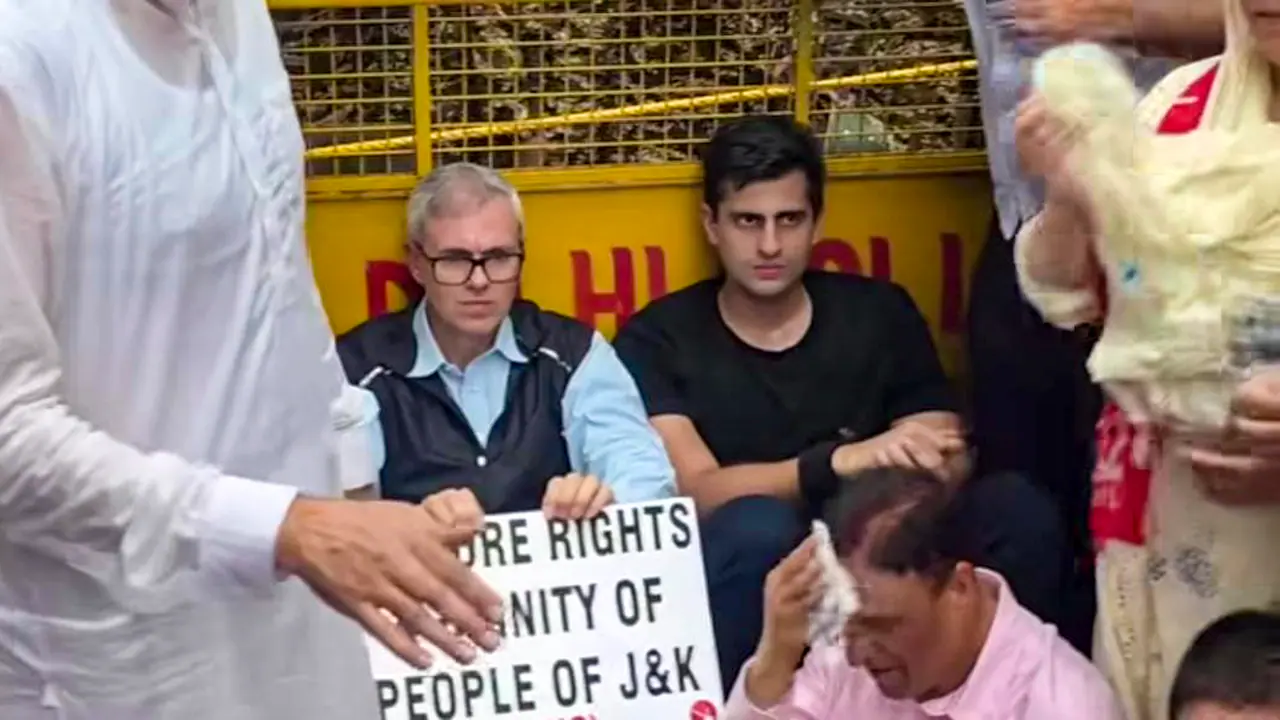
The NC has already demonstrated its willingness to carry the statehood campaign outside Jammu and Kashmir. On July 20, 2026, Farooq Abdullah, Omar Abdullah and other NC leaders and legislators held a protest in New Delhi demanding the restoration of statehood. The move was significant because it shifted the campaign from a regional political demand to a national political issue.
Omar has also indicated that the party will continue raising the issue in Parliament and through public mobilisation.
The message is straightforward: statehood should not remain an open-ended promise.
Why Statehood Has Become So Important
The distinction between Jammu and Kashmir being a state and a Union Territory is politically significant.
Under the current arrangement, Jammu and Kashmir has an elected legislative assembly but remains a Union Territory. This places it in a fundamentally different constitutional and administrative position from a full-fledged state.
For the NC, restoring statehood would represent a return to a federal political structure in which the elected government has greater constitutional standing and institutional authority.
That is why party leaders increasingly describe statehood as the minimum step toward rebuilding political confidence.
Article 370 and Statehood: Two Different Battles
An important development in the current political discourse is the separation of two demands that were previously discussed together.
Article 370
The National Conference continues to oppose the 2019 constitutional changes and maintains its broader political position regarding the restoration of Jammu and Kashmir’s special status.
Statehood
Statehood is a more immediate institutional demand that can be pursued independently of the Article 370 question.
This distinction has allowed the NC to build a campaign around an objective that does not necessarily depend on reversing the Supreme Court’s 2023 judgment on Article 370.
The Supreme Court upheld the Union’s 2019 constitutional changes relating to Article 370 and directed that Assembly elections be held by September 30, 2024, while stating that statehood should be restored at the earliest.
That legal and political distinction has become increasingly important in the NC’s strategy.
NC Wants Opposition Parties on One Platform
Farooq and Omar Abdullah have also called for opposition unity around the statehood issue.
The demand has some potential to bring together parties that remain sharply divided over Article 370.
The PDP, for example, continues to place restoration of Article 370 and the wider Kashmir political question at the centre of its agenda. In July, PDP chief Mehbooba Mufti announced peaceful district-level protests for August 5 demanding restoration of Article 370 and Article 35A and a peaceful resolution of the Kashmir issue.
The NC, meanwhile, has increasingly concentrated its immediate campaign on statehood.
This creates both an opportunity and a problem.
The opportunity is that statehood could become the common minimum programme for several regional parties.
The problem is that differences over Article 370, leadership and political strategy remain substantial.
Political Positions at a Glance
| Political Issue | National Conference | PDP |
|---|---|---|
| Statehood | Immediate and sustained demand | Supports restoration |
| Article 370 | Continues to oppose the 2019 changes | Restoration remains central |
| Political Strategy | Parliament, protests and public campaign | Public mobilisation and protests |
| Core Narrative | Dignity, democracy and federal status | Constitutional rights and Kashmir’s political identity |
| Opposition Unity | Calls for common statehood campaign | Broader focus on Article 370 and Kashmir resolution |
The difference is subtle but important: the NC is trying to turn statehood into the broadest possible political consensus, while parties such as the PDP continue to place the 2019 constitutional changes at the centre of their political messaging.
What Does the Statehood Campaign Mean for New Delhi?
The renewed campaign puts the Union Government in a politically difficult position.
New Delhi has repeatedly defended the 2019 changes on grounds of integration, governance, development and security. At the same time, the restoration of statehood has remained a separate political commitment.
The NC’s argument is that the passage of time should not dilute that commitment.
By repeatedly taking the issue to Parliament, Delhi and public forums, the party is attempting to turn statehood into a question of political accountability.
The strategy is essentially:
Promise → pressure → public mobilisation → parliamentary campaign → continued demand for restoration.
The BJP’s Development Narrative vs NC’s Statehood Narrative
The political contest is also increasingly becoming a battle of competing narratives.
The BJP and the Union Government generally emphasise development, infrastructure, investment, security and integration as measures of progress since 2019.
The NC’s argument is different.
For the party, development cannot substitute for political status.
Its leaders contend that roads, infrastructure projects and economic initiatives do not answer the question of whether Jammu and Kashmir should regain its full statehood.
That disagreement is likely to remain one of the most important political fault lines in the region.
Does the Statehood Demand Have Wider Public Appeal?
The NC believes statehood has the potential to become a broader issue than Article 370 because it can appeal across political and regional divides.
That distinction matters.
Article 370 remains a highly contentious constitutional issue, with political views varying sharply between Jammu and Kashmir and among different communities.
Statehood, by comparison, can be presented as an institutional question concerning elected representation and the status of the region’s government.
This could give the demand greater political reach.
However, claiming that all or most people in Jammu and Kashmir uniformly support the demand would go beyond the available evidence. Public opinion is complex, and political priorities differ across regions and communities.
The Biggest Challenge: Turning a Promise into a Timeline
The central question now is not whether the NC will continue demanding statehood. Its leaders have made that clear.
The bigger question is:
When will statehood actually return?
The Supreme Court’s December 2023 judgment said statehood should be restored at the earliest, but it did not impose a specific deadline for restoration.
That leaves the timing largely within the political and administrative domain of the Union Government.
For Omar Abdullah, that creates a delicate political challenge.
He must simultaneously run a Union Territory government and campaign against the continued Union Territory status.
That dual role makes the statehood question particularly important for the NC’s political credibility.
A New Phase in the NC’s Politics
The latest statements suggest that the National Conference is entering a new phase of its political campaign.
The party has already secured a mandate to govern Jammu and Kashmir. Its next major political objective is now to secure the restoration of the institutional status under which it governed before 2019.
That creates a clear political storyline:
Election victory → government formation → statehood campaign → pressure on New Delhi.
Omar’s latest remarks indicate that the party sees the campaign as a long-term struggle rather than a short-term political protest.
Conclusion: Statehood Is Now the NC’s Political Test
Seven years after the August 5, 2019 constitutional changes, the debate over Jammu and Kashmir has entered another phase.
The question is no longer limited to Article 370. Statehood has emerged as a separate and increasingly powerful political demand.
For Farooq Abdullah, it is about dignity and constitutional rights. For Omar Abdullah, it is about holding New Delhi accountable to its stated commitment and maintaining pressure through democratic institutions.
The NC’s campaign will test whether statehood can become a common political platform across Jammu and Kashmir’s fragmented opposition.
For New Delhi, meanwhile, the challenge is equally clear: the longer the statehood question remains unresolved, the longer it will remain a central political issue for the region’s elected leadership.
The fight, as Omar Abdullah has now made clear, is not ending with the seventh anniversary of Article 370’s abrogation. For the National Conference, the statehood campaign is entering its next chapter.